Roadshow Marketing Services: What Brands Need to Know
Learn what roadshow marketing services include, how specialized partners differ from generalist agencies, and what to look for when evaluating a roadshow operations partner.
If you’re searching for roadshow marketing services, you probably already know you need help. Maybe your program is growing faster than your team can manage. Maybe you’re launching your first roadshow and realizing there’s more to it than you expected. Either way, you’re looking for a partner, not just a vendor.
This post explains what roadshow marketing services actually include, what separates a specialized partner from a generalist agency, and what to expect when you bring one on.
What Roadshow Marketing Services Actually Include
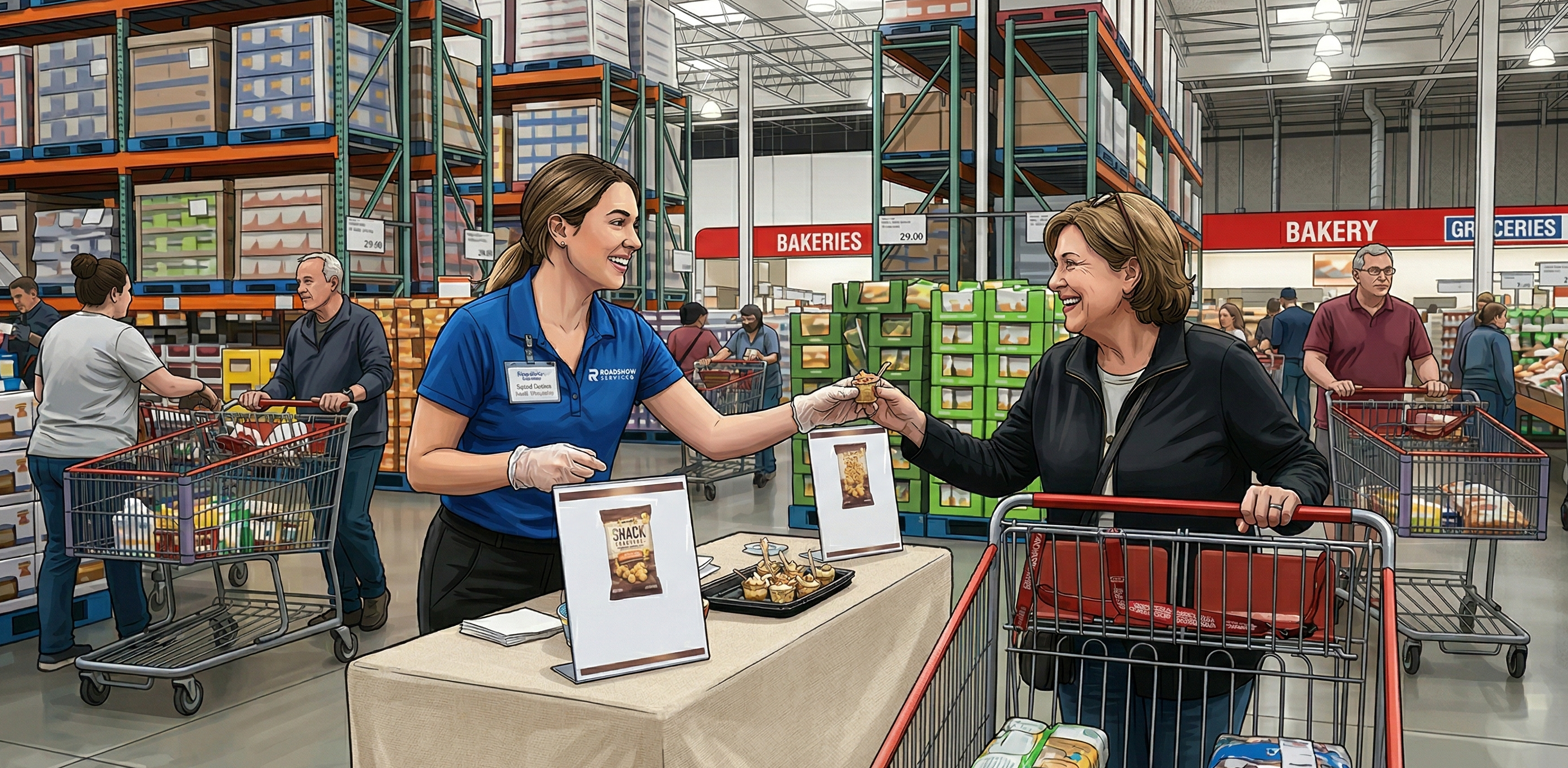
The term “roadshow marketing services” covers a lot of ground. At its core, it means outsourcing some or all of the operation behind a traveling, in-person brand activation program at major warehouse retailers.
Here’s what that typically looks like:
Program planning. Route mapping, store-level scheduling, market prioritization, and logistics coordination. For multi-state programs, this is the operational backbone that keeps everything moving on time.
Staffing and recruiting. Finding, screening, hiring, and training brand representatives in every market your program touches. This isn’t a one-time hire. It’s a continuous pipeline that runs week after week.
Training and onboarding. A good training program accounts for different learning styles, combining written materials, visual guides, quizzes, and live instruction so reps actually retain what they need to know. The depth of training scales with the complexity of the product and what the brand needs.
Compliance management. State-by-state labor law compliance: break monitoring, overtime tracking, proper classification, and retailer-specific requirements. This is the piece most brands don’t think about until it becomes a problem.
Field management and day-of support. Live time tracking, issue escalation, backup coverage, and store-team relationship management. Someone needs to be watching every show, every day, including weekends, holidays, and across all time zones.
Reporting and visibility. Operational data from the staffing side: rep hours, event completion, clock-in/clock-out records, and qualitative feedback from the floor. Combined with sales data from the retailer or the brand’s own reporting, this gives you a complete picture of program performance.
What a Generalist Agency Gets Wrong
Many brands start by hiring a general staffing agency or an experiential marketing firm. On paper it makes sense. They have people, you need people.
In practice, the fit breaks down fast.
Generalist staffing agencies can fill shifts, but they don’t understand the pace of roadshow work. The weekly recruit-hire-train-deploy cycle is faster than most agencies are built for. They’re set up for longer placements, not a rotating cast of reps across dozens of markets.
Experiential marketing firms understand brand activations, but they’re often project-based. They’ll plan and execute a single event or a short campaign beautifully. But a roadshow program isn’t a project. It’s an ongoing operation with no off-season. The infrastructure required to keep it running week after week is fundamentally different.
What both miss: compliance. Multi-state employment law, break rules, overtime thresholds, proper classification. These aren’t nice-to-haves. They’re legal requirements that vary by state, and getting them wrong creates real liability for the brand.
A specialized roadshow partner is built for this specific operational rhythm. The recruiting pipelines, compliance systems, field support, and reporting infrastructure exist because the work demands it.
What to Expect From a Good Partner
If you’re evaluating roadshow marketing services, here’s what the right partner should bring to the table:
They should know your world. A partner who specializes in warehouse retail roadshows understands the retailer expectations, the store-level dynamics, and the pace of the work. You shouldn’t have to teach them the basics.
They should have infrastructure, not just people. Recruiting pipelines, compliance monitoring, live time tracking, a bench of trained alternates for backup coverage. These are systems, not things someone figures out on the fly.
They should scale with you. Going from a handful of shows to a national program requires a fundamentally different operation. Your partner should be able to grow with you without the quality dropping.
They should give you visibility. Your partner should be monitoring the floor in real time, tracking clock-ins, handling issue escalation, and managing event status as it happens. You should receive clear, consistent reporting so you always know how your program is performing without having to chase updates.
They should take compliance seriously. Not as a line item in a proposal, but as built-in infrastructure. Ask how they track breaks, manage overtime, and handle state-specific rules. If the answer is vague, that’s your answer.
The Bottom Line
Roadshow marketing services aren’t one-size-fits-all. The right partner depends on the size of your program, the complexity of your product, and how much of the operation you want to hand off.
But the brands that get this right, the ones running programs that scale without burning out their internal teams, almost always have one thing in common: they chose a partner who was built for this work, not one who’s figuring it out alongside them.